
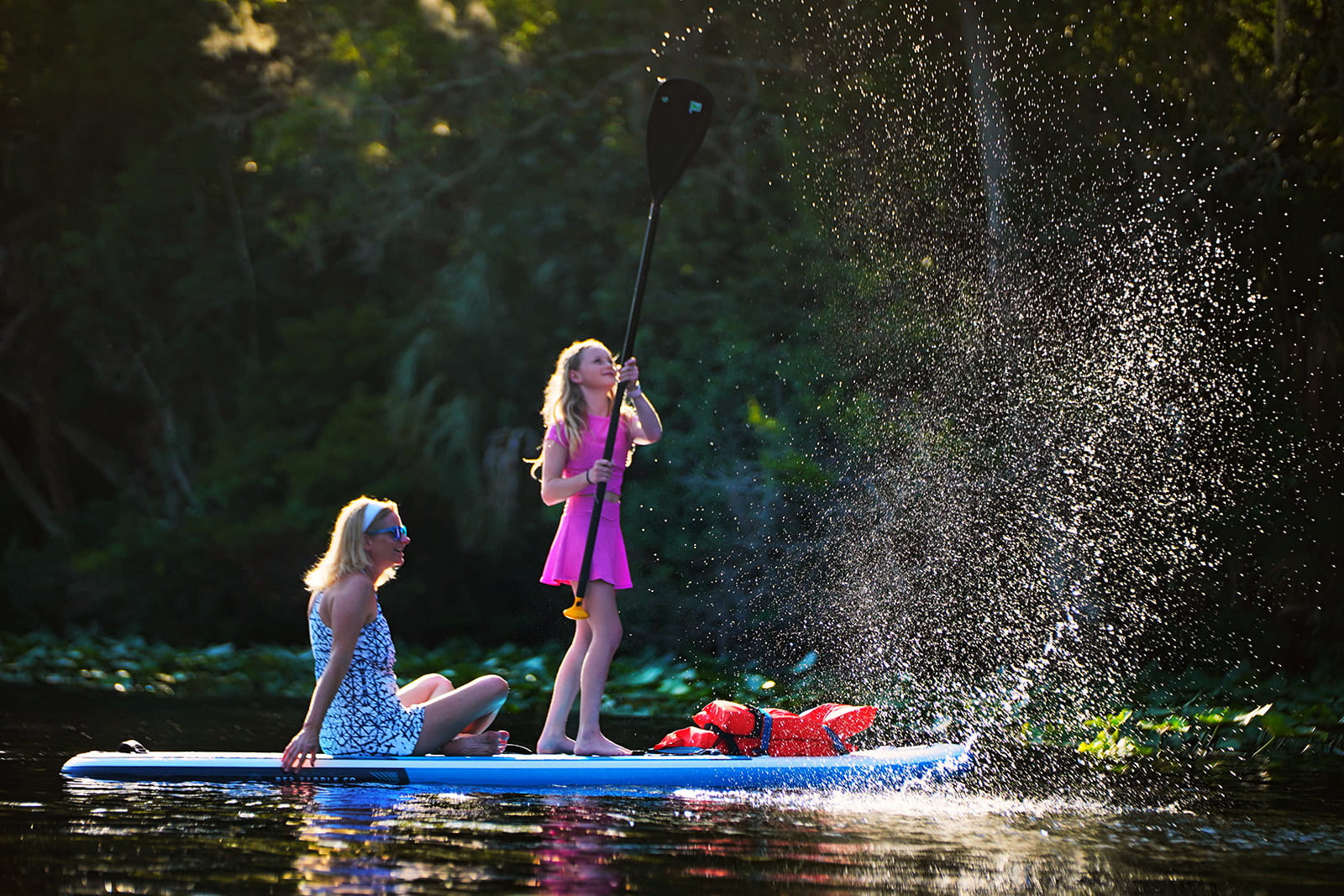
Family Paddle Days: Best Kid-Friendly Kayak and Paddleboard Trips in Orlando
Family Paddle Days: Best Kid-Friendly Kayak and Paddleboard Trips in Orlando
When planning family paddle trips, parents prioritize safety and logistics over scenery, asking about starting ages, life jacket sizing, and realistic trip lengths for kids. These crucial answers often dictate whether a trip gets booked.
Fortunately, paddling the Wekiva River requires minimal preparation. Rentals include youth life jackets, no experience is necessary, and children can easily ride with an adult in a canoe, tandem kayak, or paddleboard. The shaded, gentle waters near Wekiva Island ensure a safe bank is always close by.
Before heading out, families should understand specific age guidelines, vest sizing, and ideal boat combinations. Located 30 minutes north of downtown Orlando at Wekiva Island in Longwood, Paddleboard Orlando offers walk-up rentals and reservable guided tours. Our dockside team sizes every paddler and assists families in choosing the perfect vessel.
What Age Can Kids Start Kayaking or Paddleboarding?
Florida sets no minimum age for a child to ride in a canoe, kayak, or on a paddleboard, so the real answer comes down to how an outfitter handles supervision and how much your child can contribute once you're on the water. At Wekiva Island, guests 14 and under paddle with an adult present, though they don't have to share your boat and can ride in a vessel of their own alongside you. Renting independently starts at 14. Children under 13 ride on a parent's board at no additional charge, and we ask you to add their weight to yours at registration so our team can match you with a board sized to carry two people.
Riding along and paddling are distinct milestones. A 4- or 5-year-old can sit comfortably in a tandem kayak or canoe for a couple of hours, often holding a paddle without moving the boat. Plan distances around the adults, treating child paddling as a bonus. By age 7 or 8, most children generate real forward propulsion and can hold a line.
Behavioral signals predict readiness better than age alone. Sitting still for 30 minutes, keeping a life vest on willingly, following directions, and staying calm when wet are what matter most. A confident 6-year-old who swims well often does better than a panicked 9-year-old. Our dock team can help you choose the ideal setup.
Guided tours follow a slightly different rule. Paddlers ages 13 and older can take their own paddleboard on a supervised guided group tour, while younger kids ride with a parent. We make exceptions case by case for children with prior paddleboard or athletic experience, so tell us ages when you book, and we'll plan the boats around your group.
What Age Can a Child Start Kayaking or Paddleboarding?
Children can ride in a kayak or canoe with an adult at nearly any age, and kids between 5 and 12 can paddle short distances on calm water in a child-sized kayak, according to Paddling Magazine's youth kayak buying guide. Longer trips are a different question, since smaller paddlers can't keep pace over distance and are better paired with an adult in a tandem boat. At Paddleboard Orlando, children 14 and under paddle with an adult present, and kids under 13 ride free on a parent's paddleboard. Renting a vessel on your own starts at age 14.
Tandem Kayaks vs Solo Boats for Families With Young Children
The real decision for a family with young children is whether your child rides with you or takes a boat of their own. At Wekiva Island, anyone 14 and under paddles with an adult present, and renting independently starts at 14, so for most families with elementary-age kids, the question is which shared setup fits. Tandem kayaks rent for $57 before 4 PM and $45 after, singles run $47 and $35, and paddleboards go for $53 and $40.
Tandem kayaks are the default choice for kids aged 6 to 10, giving them a job paddling in the bow while an adult steers from the stern. The boat tracks well even when the child stops paddling. However, the fixed position offers little room to move, making it a poor fit for toddlers.
Solo kayaks suit kids who can hold a line and keep pace. Strong 11- or 12-year-olds can paddle alone, as rules allow children 14 and under to use their own vessel if accompanied by an adult. Keep initial trips short, as towing a tired child is difficult.
Paddleboards are ideal for kids who love getting wet. Children under 13 ride free, sitting or kneeling at the nose while an adult paddles from behind. Boards are sized to your combined weight, which is why child weight is required at registration. It is perfect for kids who want to swim but a poor choice for those who prefer staying dry.
Families with a mix of ages usually split across boats rather than forcing everyone into one boat. If your youngest is under 6 and none of the above sounds right, our two- and three-seater canoes put a small child in the middle between two adults with room to move around. Call us at 407-862-1500 before a larger trip, and our team will sort out the combination that fits your ages and headcount.
Life Vest Requirements and Sizing for Kids on the Water
Every rental at Wekiva Island comes with a U.S. Coast Guard-approved life jacket for each paddler, and we stock youth sizes so you don't have to bring your own. Child vests are approved by weight rather than by age, which is why the label matters more than how old your kid is. Two 8-year-olds can need different sizes, and the one who needs the smaller vest is not the one who will tell you so. Our team sizes kids at the dock before anyone gets in a boat.
Fit is where most parents get tripped up, usually by buying room to grow. A vest that rides up is a vest that can come off over a child's head in the water, so it should sit snug with every strap, zipper, and buckle fastened. Safe Kids Worldwide recommends a quick check: pull up on the shoulders of the jacket, and if it reaches the child's chin or ears, the vest is too big or the straps are too loose. Tuck the loose ends of the straps so nothing catches on a paddle or a grab handle.
Smaller children need features that older kids don't. A padded collar supports the head and keeps a small face out of the water, and a strap that runs between the legs stops the vest from sliding upward. Flotation aids designed for canoeing and kayaking give kids more freedom of movement in their arms, which matters over a two-hour paddle when a stiffer vest starts to chafe. Water wings, pool floats, and inflatable rafts are not flotation devices and don't count toward anything.
Infants are the one case where the answer is to wait. The Coast Guard advises against bringing infants on recreational boats, since life jackets for newborns weighing up to 18 pounds may not fit well enough to perform as intended. A vest that can't hold a baby's head clear of the water offers no real protection, and the Wekiva is a trip worth saving until your child is bigger. Families with an infant often book a group tour for the older kids and trade off on shore at the island.
Do Kids Have to Wear a Life Jacket on a Kayak in Florida?
Yes. Florida law requires children under 6 to wear a USCG-approved Type I, II, or III personal flotation device on any vessel under 26 feet while it is underway, and every canoe, kayak, and paddleboard falls under that length. Underway means anything other than anchored, moored, tied to shore, or aground, so a child that age keeps the vest on from launch until you're back at the dock. Kids 6 and older aren't covered by the mandatory wear rule, though every person on board must have a properly sized vest within easy reach. Paddleboard Orlando provides youth-sized life jackets with every rental.
How Long Should a Family Kayak or Paddleboard Trip Last With Kids?
Most guests at Wekiva Island paddle for 2 to 3 hours and have all vessels back by 6 PM, which is a comfortable window for adults and a long stretch for a 6-year-old. With kids under 8, plan on 60 to 90 minutes of actual paddling and build the rest of the time around stops. A trip that ends while everyone is still having fun gets you a second trip. A trip that ends with a tired kid crying in the bow does not.
Plan by the clock instead of distance. Set a turnaround time before launching, split it in half, and head back when that first half ends. Starting upstream lets the current carry you back when the kids are tired and you are paddling for three. Our field guide notes short 1- to 1.5-mile river segments for this purpose.
Expect frequent stops for kids to look at wildlife, snack, or swim. Budgeting half your time for these breaks makes the trip smoother. Parents who adjust plans and drift a mile generally have a better experience than those who strictly push toward a destination.
Guided trips run a little longer and are easier to manage because someone else is watching the clock. Our group tours last about 2.5 hours with a break in the middle, which works well for kids around 8 and up who can handle a steadier pace. For younger children, a self-guided rental gives you the freedom to cut things short without holding up a group. Either way, an early arrival gives you the pick of the boats and the coolest part of the day.
How Long Should a Family Kayak Trip Last With Young Kids?
Plan for 60 to 90 minutes of paddling with children under 8, and treat anything beyond that as bonus time. The Florida Department of Environmental Protection classifies a beginner paddling trip as 1 to 5 miles on protected waters, and families with young kids should aim at the bottom of that range rather than the top. Setting a turnaround time before you launch works better than picking a destination, since a short trip that ends well beats a long one that ends in a meltdown. Most guests at Paddleboard Orlando paddle 2 to 3 hours total, including stops.
Choosing Between Kayaking and Paddleboarding for Your Family
The deciding factor is usually what your child wants to do with the water rather than which sport looks better in photos. Kids who want to sit, watch for turtles, and stay mostly dry do better in a kayak. Kids who want to slide into the river every 10 minutes and climb back out are happier on a board. Ask your child that question directly before you get to the dock, and the choice tends to make itself.
Kayaks put everyone low in the water, with a seat, a backrest, and a place to stash a water bottle. A child in the bow of a tandem sits inside the boat with an adult behind them, which reassures nervous kids and gives anxious parents a clear line of sight. The low profile also makes wildlife easier to spot, since you're closer to eye level with whatever is sunning on a log. Kids who like structure and a clear job tend to settle into a kayak faster than onto a board.
Paddleboards trade containment for freedom of movement. Kids can sit cross-legged at the nose, kneel, or stand once they find their balance, and getting back on after a swim is part of the appeal for most of them. Boards suit families who plan to spend as much time in the water as on it. Paddlers 13 and up can take their own board on a guided tour with supervision.
Families rarely have to pick just one. Split the group between the two and let the water-loving kid share a board while the cautious one rides a kayak with the other parent. Neither option requires experience, since our team walks you through the basics at the dock, and our vessel skills and safety videos cover steering, stopping, and getting back on your boat before you ever drive out. If you're stuck between the two when you arrive, tell our staff your kids' ages and what they're excited about, and we'll set you up accordingly.
What to Pack for a Family Paddle Day With Kids
Pack light, as gear must fit in the boat and tolerate splashes. Since Coast Guard-approved life jackets, including youth sizes, are provided, you can skip packing them. Prioritize water and snacks, which kids consume quickly. A soft-sided cooler is best for drinks, as small coolers are allowed on vessels but prohibited on the island.
Keep these essentials in the boat rather than the car:
- Extra refillable water bottles for everyone.
- Heat- and moisture-resistant snacks to keep kids happy.
- Sunscreen for mid-trip reapplication.
- A phone in a waterproof case, or leave it secured in the vehicle.
Dress kids in swimwear or quick-drying athletic clothes, ideally with long-sleeve rash guards for maximum sun protection. Use hats with chin straps so they do not blow into the river. Go barefoot on paddleboards and wear water shoes in canoes or kayaks; leave regular sneakers, towels, and dry clothes in the car. Restrooms and changing areas are available on-site.
Leave pets and alcohol at home, as they are prohibited at Wekiva Island and on the river. Do not bring inflatable floats or water wings, which are unsafe for boating. Finally, bring $2 per person in cash if you plan to walk into Wekiwa Springs State Park after your paddle.
How Do You Protect Kids From the Sun on a Paddle Trip?
Cover up first and use sunscreen as backup, reapplying every 2 hours and after any swim or towel-off, which is the American Academy of Pediatrics recommendation. Sun protection is harder on the water than on land because the surface reflects UV rays back up at faces, ears, and the undersides of arms that shade normally covers. Long-sleeve rash guards, wide-brim hats with chin straps, and sunglasses handle most of the exposure without needing reapplication. On the Wekiva River, tree cover along much of the run gives families more natural shade than an open lake would.
Best Water Conditions for First-Time Family Paddling Trips
The ideal water for a first family trip is narrow, slow-moving, and sheltered from the wind. Unlike open lakes, which can quickly become choppy and tiring, a tree-lined river like the Wekiva River offers shade, a windbreak, and quick access to dry land. Fed by Wekiwa Spring, it remains clear and cool year-round.
Utilizing the current correctly is essential: head upstream first while everyone is fresh, then let the gentle flow carry you back when enthusiasm fades. Upstream paddling on the Wekiva is manageable for families, though it is more noticeable in a loaded canoe than a tandem kayak. Planning the reverse often results in a difficult return leg with tired children.
Morning is the best window most of the year. The water is glassier before the day heats up, wildlife is more active, boat traffic is lighter, and you avoid the afternoon thunderstorms that build on a near-daily cycle through a Florida summer. Weekdays are noticeably quieter than weekends, and since rentals are first-come, first-served, arriving early on a Saturday is the difference between paddling and waiting. We do reach capacity on holidays and busy weekends.
Call it early if conditions turn. Wind picking up, a line of dark clouds building, or the first rumble of thunder are all reasons to head back, and a short family trip is easy to cut short since you're rarely more than a mile from the launch. Our staff monitors conditions and will tell you what the river looks like that day before you push off. Asking at the counter takes 30 seconds and saves you from guessing.
What to Expect on a Guided Family Paddle Tour
A guided tour takes most of the planning out of a family paddle day, which is the main reason parents book one. Group tours run about 2.5 hours with a break in the middle, and they're built for beginners, so nobody in your group needs prior experience. Check-in is at 9:00 AM with launch shortly after, which puts you on the water while it's still cool and back before the afternoon heat sets in. Everything is included: an expert guide, a safety demonstration before you launch, premium equipment, and photos and video from the trip.
The tour starts on land with a briefing covering how to hold the paddle, how to steer, what to do if you go into the water, and what wildlife you're likely to see. Kids pay closer attention to a guide than to a parent, which is worth the reservation fee on its own. From there, the group paddles upriver toward the spring at a pace set for the slowest boat, so there's no pressure to keep up. The break partway through gives everyone a chance to stretch, snack, and swim if the weather cooperates.
Family groups have two vessel options on a tour: kayaks and paddleboards. Children under 13 ride free on a parent's board with their weight added at registration, and paddlers 13 and up can take their own board with supervision. Exceptions for younger kids are handled on a case-by-case basis and require extensive prior paddleboarding or athletic experience, so call us at 407-862-1500 if that describes your child, and we'll talk it through. Tours accommodate anywhere from 4 to 400 guests, ranging from a single family to a full reunion.
Booking works differently from renting. Tours require a reservation and must be prepaid in full before your paddle day, while walk-up rentals are first-come, first-served and can't be reserved. That difference works in a family's favor, since a booked tour means a guaranteed boat, a guide, and a start time you can plan a trip around. Include everyone's ages when you book so our team can sort out vessels ahead of time.
Afterward, nobody has to rush off. Wekiva Island has riverside seating, cabanas available to rent, and everything you need for a full day on the water, including food, refreshing drinks, and other essentials. Grab lunch at the Without a Paddle Cafe while the kids dry off. When you're ready to plan your family's trip, book a tour or come out early on a weekday for a walk-up rental.
Frequently Asked Questions About Family Kayaking and Paddleboarding
Can a baby or toddler ride in a kayak?
A toddler can ride in a canoe or tandem kayak with an adult, and there's no minimum age to ride along at Wekiva Island as long as a supervising adult is present. Infants are a different answer, since the Coast Guard advises against bringing them on recreational boats at all until they're big enough for a life jacket to fit properly. For toddlers, a canoe usually works better than a kayak because the open hull gives a small child room to shift around without unsettling the boat.
Do kids need their own paddle or can they ride without paddling?
Kids can ride without paddling, and most young children do for at least part of the trip. Plan your distance around the adults doing the work, since a 5-year-old with a paddle contributes enthusiasm more than propulsion. Children who want to help are welcome to, and many kids paddle in bursts, stop to watch a turtle, and pick it back up 10 minutes later.
What happens if a child falls in the water during the trip?
Everyone on the water wears or carries a Coast Guard-approved life jacket, and we size youth vests at the dock before anyone launches, so a child who goes in comes right back up. The Wekiva is calm and narrow through the stretch most families paddle, and the bank is rarely far away. On a guided tour, your guide handles the situation and gets your child back on board. Kids on paddleboards often go in on purpose, which is part of why they like boards in the first place.
Can one parent handle a tandem kayak with two kids alone?
A tandem kayak seats two, so one adult and two children won't fit in a single tandem. A three-seater canoe is the setup that works for one adult with two kids, since it carries three people and gives the children room in the middle. If your kids are old enough to manage their own boats, a solo parent can also paddle alongside two singles, keeping in mind that anyone 14 and under needs an adult on the water with them.
Is there a weight limit for tandem kayaks with kids and adults?
Every vessel has a manufacturer capacity, and a tandem kayak carrying an adult and a child is well within it in most cases. Paddleboards are the setup where weight matters most to us directly, which is why we ask you to add your child's weight to yours at registration so our team can match you with a board sized for two riders. If you're paddling with a larger group or are unsure about a particular combination, call us at 407-862-1500, and we'll sort out the right boats before you drive out.
Are guided tours safer for families than self-guided rentals?
Both are safe; the difference lies in supervision rather than risk. A guided tour includes a safety demonstration, an expert guide who sets the pace and watches over the group, and equipment matched to each paddler, taking the decision-making off your plate. A self-guided rental gives you the freedom to turn around whenever your kids are done, which suits families with younger children. Our team gives every renter a quick how-to at the dock either way.

1014 Miami Springs Drive
Longwood, FL 32779
Friday & Saturday 8 AM – 11 PM