
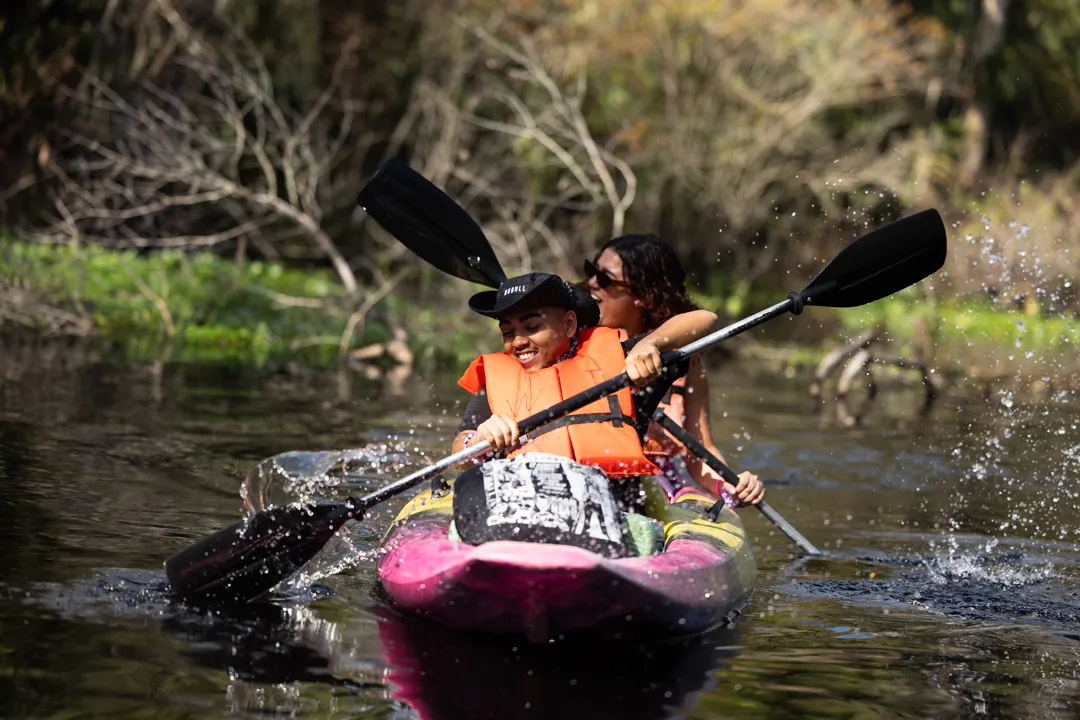
Learning to Kayak: Essential Techniques & Skills for Beginners
Kayaking has a reputation for being harder than it actually is. Watch a smooth paddler glide across calm water, and it looks like something that takes years and serious upper-body strength to pull off. It doesn't.
Almost anyone can be paddling comfortably within their first hour, and the gap between a clumsy, tiring start and an easy, enjoyable one comes down to a handful of techniques that are simple to learn once someone shows you how.
We've spent years teaching first-timers on the Wekiva River, and the same truth holds for nearly everyone who climbs into a boat for the first time: good form does the heavy lifting.
When you rotate your torso instead of yanking with your arms, sit with relaxed hips instead of bracing rigidly, and hold the paddle the way it's meant to be held, the kayak starts working with you. Strength helps, but technique is what keeps you out on the water longer and grinning the whole time.
The core skills add up quickly. The forward stroke, steering, balance, a clean way in and out of the boat, and a calm response if you tip over are the foundation, and none of them takes long to pick up.
Add the handful of mistakes we see most often and a simple path for building endurance, and you have everything you need to start strong. Learn these fundamentals early, ideally on calm water, and you skip the frustrating trial-and-error stage that turns some first-timers off the sport for good.
Why Proper Kayaking Technique Matters From Your First Paddle
Most people assume kayaking comes down to upper-body strength. It doesn't.
Technique decides whether your first hour on the water feels effortless or leaves your shoulders aching by the halfway point. A paddler with clean form and average fitness will out-cruise a strong paddler with bad habits every time, and they tend to finish the day wanting to come back.
Good technique starts paying off on the very first stroke. When you rotate your torso instead of yanking with your arms, each stroke moves more water with less effort. When you sit tall with relaxed hips, the boat stops feeling tippy and starts feeling planted.
These are not advanced skills reserved for veterans. They are the fundamentals that separate a frustrating first trip from one that turns into a new hobby.
Form keeps you safer, too. A paddler who knows how to sit, grip the paddle, and read the water stays calm when the hull wobbles or a wake rolls through.
Most beginner capsizes come from panic, and panic comes from not knowing what your body is supposed to do. Building the right movements early trades that uncertainty for confidence.
Calm, protected water speeds up the learning curve. The spring-fed Wekiva River runs slow and clear, giving first-timers a forgiving place to build muscle memory before they ever deal with open water or current.
Renting a stable, beginner-friendly kayak on water like this lets you focus on technique rather than fighting the conditions. Plenty of paddlers find that one guided outing with an instructor locks in the basics faster than weeks of trial and error.
Does learning proper technique really matter for beginners?
It does, though the payoff is less about danger and more about how quickly the sport clicks.
A solid forward stroke, basic edging, and a practiced wet exit turn a tippy, tiring first outing into an easy one. That is why reputable instruction is built around individual attention: ACA kayak skills courses are capped at five students per instructor, so beginners get real feedback on their technique instead of guessing.
Paddlers who start this way tend to feel more comfortable sooner and enjoy the sport much more from the very first trip.
The Forward Stroke: Master Your Basic Paddling Motion
The forward stroke is the one you'll use more than any other, so it earns the most attention. Done well, it moves the kayak with smooth, efficient power and almost no strain on your shoulders. Done poorly, it burns out your arms within minutes and leaves the boat veering from side to side. The motion is simple once you understand where the power actually comes from.
It comes from your torso, not your arms. Picture your core as a wound spring. You rotate your trunk to plant the blade, then unwind that rotation to pull the boat forward. Your arms mostly hold the paddle in position while the bigger muscles in your back and core do the heavy lifting. A relaxed grip helps here. Form a loose "O" with your thumb and index finger around the shaft and rest the other fingers lightly, which keeps your forearms from cramping.
Most instructors break the forward stroke into three phases:
- Catch: Wind your torso and plant the blade fully in the water, close to the hull, just beside your feet.
- Power: Unwind your torso and pull the boat past the blade, finishing as your lower hand reaches your hip.
- Release: Slice the blade cleanly out of the water at your hip and set up the catch on the other side.
A useful mental image is planting the blade in wet cement. The paddle barely moves. Instead, you pull yourself forward past the spot where it went in. Keep your strokes short by exiting at the hip rather than dragging the blade behind you, and hold your top hand around shoulder height so the blade stays at the right depth. The stroke clicks faster for most beginners after a few corrections from an instructor on a guided tour than from watching videos alone, since small flaws in your catch and rotation are hard to spot on your own.
How to Steer and Turn a Kayak with Precision
Steering a kayak has little to do with brute force and everything to do with picking the right stroke. New paddlers often try to muscle the boat around by jamming the paddle or just paddling harder on one side. That sort of works, since repeating a forward stroke on one side slowly pushes the bow the other way, but it wastes energy and kills your glide. The efficient tool for turning is the sweep stroke.
The forward sweep turns the boat while keeping you moving. Wind your torso and plant the blade near your toes, then draw a wide arc out to the side, as if you're tracing a big "C" on the water, finishing near the stern before you slice the blade out. Power the arc by unwinding your torso instead of pulling with your arm. The first third of the sweep does most of the turning, so reach well forward and keep the arc wide. To spin in place, pair a forward sweep on one side with a reverse sweep on the other.
Edging makes turns sharper. Tilt the kayak slightly toward the side you're sweeping on by weighting that hip and lifting the opposite knee, and keep your head centered over the boat. The tilt lifts the bow and stern a touch and lets the hull carve instead of plowing. Edging feels unnerving at first, so practice it in calm water in a stable rental kayak where a small tilt won't turn into a tip.
One note on equipment. Some touring and sit-on-top kayaks include a rudder or skeg that helps hold a line or turn in wind, but most beginner recreational kayaks steer entirely with your strokes and edge. Learning to turn with paddle and body first makes you a stronger paddler in any boat.
Balance and Posture: Building Stability While Paddling
Balance in a kayak comes from how you sit, not from holding rigidly still. The most common beginner instinct is to lock up and brace against every wobble, which actually makes the boat feel tippier. Stability improves when your lower body stays connected to the boat and your upper body stays loose and upright.
Start with posture. Sit up tall, with your sit bones pushed back in the seat and your spine stacked rather than slouched, roughly with your chin over your belt buckle. Leaning back strains your lower back and pulls your weight out of the boat's stable range. A slight forward lean is fine and even helps you rotate. Good posture keeps your center of gravity low and centered, which is exactly where you want it.
Next, build your points of contact. Rest the balls of your feet on the foot pegs, let your knees or thighs touch the inside of the hull lightly, and settle your hips into the seat. Those contact points let you feel what the boat is doing and move with it. The goal is loose hips. You want the kayak free to rock side to side underneath you while your head and shoulders stay level over the centerline.
It helps to understand two kinds of stability. Primary stability is how steady the boat feels sitting flat on calm water, and beginner recreational kayaks are built with plenty of it. Secondary stability is how steady it feels once tilted onto its edge. New paddlers often read a little initial wobble as danger, but a boat can feel lively and still be very hard to flip. On flat water like the Wekiva, that initial steadiness gives you room to relax, loosen your hips, and trust the boat.
Entering and Exiting Your Kayak: The Correct Way
After years of launching first-timers off our dock, we can tell you that more beginners get wet climbing in and out than ever do while actually paddling. The launch and the landing are where balance is most fragile, because your weight sits high and the boat wants to slide out from under you. We teach one rule that covers nearly every situation: get your seat down and your center of gravity low as fast as you safely can.
From a dock, line the kayak up parallel to the edge, with its lowest point facing the water. From there:
- Sit on the dock beside the cockpit with your feet resting inside the boat.
- Grip the dock firmly with both hands and turn your body toward the bow.
- Lower yourself smoothly and quickly into the seat, keeping your weight low.
- Settle in, grab your paddle, and push off.
Getting out reverses those steps. Hold the dock, slide your weight onto it seat-first, then lift your legs out. We always remind people not to stand while they're still partly in the boat, because that is exactly where we see most dock-exit spills.
On a beach or shoreline, we point the bow toward the water with the kayak perpendicular to shore and the cockpit floating in a few inches of water. Straddle the boat with a foot on each side, lower yourself into the seat, then swing your legs in one at a time. Your paddle makes a handy brace here. Lay it across the deck just behind the cockpit with one blade on shore, and lean on it lightly like an outrigger as you settle in.
Calm, shallow water makes all of this far easier, which is part of why we like teaching beginners here. Our crew steadies your boat at the dock and walks first-timers through the launch before anyone pushes off, so you can focus on getting comfortable instead of worrying about the entry.
What to Do If You Capsize: Recovery Techniques and Practice
Capsizing is part of kayaking, and even paddlers we've guided for years go over now and then. The flip itself is almost never the problem. Panic is. When beginners tip and freeze, a harmless dunk turns stressful, so the first thing we teach is to expect it, stay calm, and trust that your gear is built to keep you safe.
In a sit-on-top kayak, recovery is simple. You slide off, flip the boat upright, swim to the side near the middle, and climb back on while keeping your weight low. Sit-on-top and open-cockpit recreational kayaks, the kind most beginners rent, make getting back aboard far easier than people expect.
In a sit-inside kayak without a spray skirt, you perform what's called a wet exit. As you go over, lean forward toward the deck, put your hands on the sides of the cockpit, push your knees together, and slide yourself out. Your life jacket floats you up. Take a breath, then hang onto two things: your boat and your paddle. The kayak is your largest piece of flotation, and it's far easier to spot than your head alone, so we always tell people to stay with the boat rather than swim off after a dropped water bottle.
Practice makes this automatic. It's worth running through a wet exit and re-entry once in calm, shallow water before you head anywhere open, because muscle memory beats improvisation when you're suddenly upside down. If you'd rather start with guidance, our first-timer's tour begins with a lesson to get you comfortable on the water before the paddle.
Where can beginners practice kayaking in Florida?
Once a wet exit and re-entry start to feel automatic, the best place to build on them is calm, flat water close to home, and Florida has plenty of it. The state maintains more than 60 designated paddling trails totaling over 4,100 miles, with routes rated for every skill level from beginner to advanced. That lets you pick a slow, sheltered stretch to get comfortable before working up to anything open or fast. (Source: Florida Department of Environmental Protection, Florida's Designated Paddling Trails.)
Common Beginner Mistakes: Fixing Poor Paddling Form
The good news about beginner mistakes is that they're predictable, which makes them easy to fix once you know what to watch for. The same handful of habits show up on nearly every first paddle, and most disappear within an outing or two of conscious correction. Here are the ones we see most often, with the fix for each:
Most instructors break the forward stroke into three phases:
- Death-gripping the paddle. A white-knuckle hold tires your forearms fast and raises blisters. Loosen into that relaxed "O" grip and let your fingers rest on the shaft.
- Paddling with your arms only. Arms alone run out of gas quickly. Drive each stroke with torso rotation so your stronger core and back muscles do the work.
- Leaning back in the seat. A reclined, couch-like posture shuts off your torso and shortens every stroke. Sit upright and neutral, with a slight forward lean if anything.
- Staring at the bow. Looking down hurts your balance and your heading. Lift your eyes toward where you want to go, and the boat tends to follow.
- Holding the paddle backward. Turn the scooped, concave face toward you so it grabs water on the pull, and set your hands a little wider than shoulder width.
One more habit worth breaking early is sprinting off the dock. New paddlers tend to attack the water with fast, hard strokes and burn out within minutes. Slow down. Smooth, deliberate strokes cover more distance with less effort and give you time to feel what your body and the boat are doing. Form beats force every time, and the paddlers who relax into it are the ones still smiling at the end of the day.
Building Paddling Endurance: Progressive Skill Development
Endurance on the water is built, not born, and it comes from progression rather than one exhausting push. The paddlers who last all day are rarely the strongest. They're the ones with efficient form, because good technique stretches your energy much further than raw muscle ever will. Every skill covered so far feeds into this. A clean forward stroke, smooth sweeps, a relaxed grip, and confident balance all add up to a paddler who can go longer and enjoy more of it.
The smart way to build stamina is to start short and stay consistent. A first outing of 30 to 60 minutes on calm water is plenty. Pay attention to form while you're fresh, since sloppy habits creep in as you tire. As the basics start to feel automatic, add time and distance gradually instead of doubling your trip all at once. Regular outings, even short ones, build the specific paddling muscles and the muscle memory far faster than the occasional marathon session.
Progression also means layering in new skills as the old ones settle. Once your forward stroke feels natural, sharpen your turns. Once turning clicks, work on edging and bracing. Each skill makes the next one easier, and before long the movements you once thought about constantly just happen. That steady climb from nervous first-timer to relaxed, capable paddler usually takes only a handful of outings.
There's no better place to put in those reps than calm, protected water. The spring-fed Wekiva River gives beginners a forgiving, beautiful stretch to build skills and stamina at their own pace, which is exactly what we love helping people do at Paddleboard Orlando. Rent a kayak for a half day, take it slow, and let each trip build on the last.
How Popular and Beginner-Friendly Is Kayaking?
Very. Recreational kayaking became America's most popular paddlesport in 2017 and still leads the field, with the highest share of frequent participants of any paddling discipline. Nearly 30 million Americans went paddling in the most recent year measured, up 22% since 2019, according to the Outdoor Industry Association's participation report. The sport keeps growing largely because it's approachable: with a little instruction and calm water, most beginners are paddling confidently on their first outing.
Frequently Asked Questions About Kayaking Technique
How Do I Hold a Kayak Paddle Correctly?
Hold the shaft with both hands a little wider than shoulder width, knuckles up and roughly in line with the blades. Keep a relaxed grip by forming a loose "O" with your thumb and index finger, and resting your other fingers lightly, which helps prevent forearm fatigue and blisters. Make sure the scooped, concave face of each blade pulls toward you as you stroke.
What Is the Proper Sitting Position in a Kayak?
Sit upright with your sit bones pushed back in the seat and your spine stacked, roughly with your chin over your belt buckle. A slight forward lean is good, while leaning back shuts off your torso and makes paddling less efficient. Rest the balls of your feet on the foot pegs and let your knees touch the hull lightly so you stay connected to the boat while your hips stay loose.
How Do I Turn a Kayak With Better Control?
Use a forward sweep stroke instead of just paddling harder on one side. Plant the blade near your toes and draw a wide arc out to the side, finishing near the stern before you slice it out, and power the arc with torso rotation rather than your arm. To turn more sharply, add a little edging by tilting the boat toward the side you're sweeping on while keeping your head centered over the kayak.
Will I Fall Over If I Move Too Much in a Kayak?
Probably not. Beginner recreational kayaks are built with high primary stability, so they feel steady on flat water and tolerate a surprising amount of movement. The trick is to keep your hips loose and your head centered over the boat, letting the kayak rock beneath you rather than stiffening against every wobble. Tension causes more capsizes than movement does.
How Do I Practice Kayaking Skills Between Paddle Trips?
You can rehearse torso rotation on dry land by holding a broomstick across your shoulders and twisting from the waist, which grooves the motion without a boat. Core and back exercises like planks and rows build the muscles that power an efficient stroke. The fastest progress, though, comes from frequent short outings on calm water, since nothing replaces time spent feeling how the boat responds.
What Paddle Technique Mistakes Should I Avoid?
The most common ones are gripping the paddle too tightly, paddling with your arms rather than your torso, leaning back in the seat, and staring down at the bow rather than looking ahead. Each has a simple fix: relax your hands, rotate your core, sit upright, and lift your eyes toward where you want to go. Starting with slow, deliberate strokes instead of sprinting off the dock also saves a lot of wasted energy.

1014 Miami Springs Drive
Longwood, FL 32779
Friday & Saturday 8 AM – 11 PM