
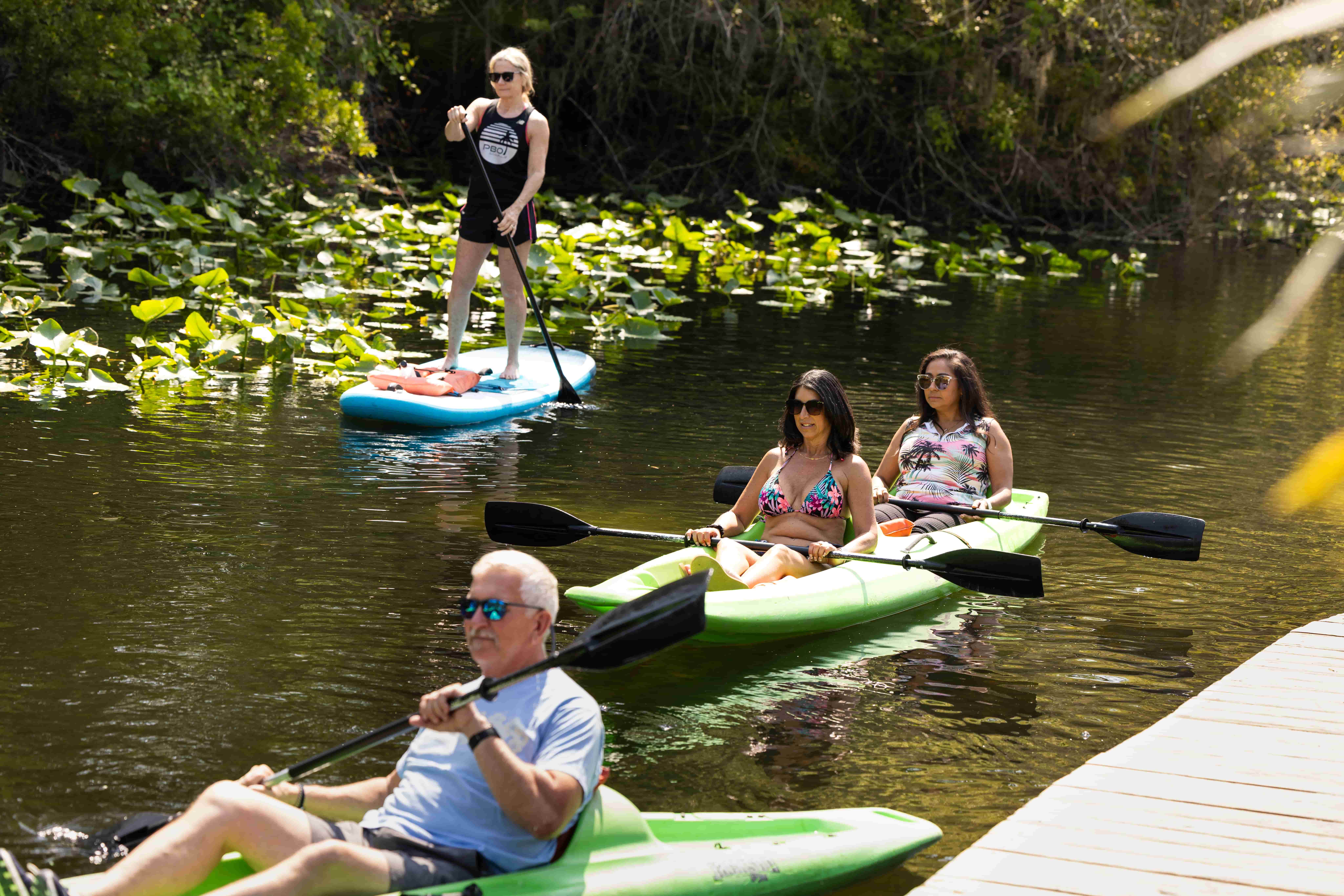
Paddleboarding vs Kayaking: Which Water Sport is Right for You?
Florida has no shortage of ways to get out on the water, but two stand out as the most accessible, the most rewarding, and the most debated: paddleboarding and kayaking.
Both get you outside, both put you on some of the most beautiful waterways in the country, and both are genuinely enjoyable from your very first outing. But they are not the same experience, and choosing between them is worth thinking through before you show up at the water's edge.
The comparison comes up constantly at Paddleboard Orlando on the Wekiva River. First-timers want to know which is easier. Fitness-focused paddlers want to know which works harder. Families want to know which is safer for kids. Groups want to know which is more fun.
The honest answer to all those questions is: it depends, and this guide is built to help you figure out what it depends on.
What follows is a straightforward breakdown of how paddleboarding and kayaking compare across the factors that actually matter: difficulty, fitness, water conditions, cost, storage, activity type, and timing.
Neither sport wins every category, and that is the point. The right choice is the one that fits how you want to spend your time on the water. By the end of this guide, you will know exactly which one that is, and you might find yourself curious about trying both.
Paddleboard vs Kayak: Key Differences Between SUP and Kayaking
Both paddleboarding and kayaking get you out on the water with a paddle in hand, but that's roughly where the similarities end. The two sports feel completely different in practice, attract different types of paddlers, and each has clear advantages depending on what you're looking for.
The most fundamental difference is your position. A kayak uses a double-bladed paddle with the paddler sitting down in either an enclosed cockpit or on an open deck, while a paddleboard requires standing on a flat platform and using a single-bladed paddle. That positional difference drives almost every other comparison between the two, from how your body works to how each craft handles the water around it.
From a design standpoint, most paddleboards feature a flat, planing hull designed to skim across the water's surface, while kayaks use a displacement hull that cuts through the water for better tracking and efficiency over longer distances. In plain terms, kayaks move in a straighter line with less effort, while paddleboards trade some of that efficiency for a more open, versatile platform.
Neither sport requires specialized athletic ability to enjoy at a recreational level, which is a big part of why both have become fixtures on Florida waterways. And neither is objectively better. The right choice depends on your goals, your comfort level, and the kind of experience you want.
The sections below break it all down.
Which Is Easier for Beginners: Paddleboarding or Kayaking?
Honest answer: Kayaking has a gentler first five minutes. Sitting low in a kayak gives you a lower center of gravity right away, and the double-bladed paddle makes it easier to move in a straight line without much technique. Most people can get comfortable in a recreational kayak within a single session on calm water.
Paddleboarding takes more patience upfront. Standing on a moving platform requires balance adjustments your body hasn't made before, and that first wobbly stretch is real. The hardest part of paddling a SUP is learning how to maintain balance, but once you get the hang of it, you're ready to go.
That said, the gap closes quickly. While you can have a successful kayak outing with little to no experience, first-time paddleboarders who stick with it typically find the basics click within a few hours. Once balance is no longer the main focus, paddleboarding has fewer technical elements to manage.
One area where paddleboarding has a real beginner advantage is recovery. Paddleboards are much easier to climb back onto after a fall compared to kayaks, where re-entering can be tricky for newer paddlers. Climb on from the side, get to your knees, and go.
For groups or families on the Wekiva River, both work well on calm Florida waterways. If you have younger kids or anyone with balance concerns, starting in a canoe or kayak is often the more comfortable call. If the group is reasonably active and up for a small challenge, paddleboarding is the one people talk about afterward.
Calorie Burn and Fitness: Do Paddleboards or Kayaks Provide a Better Workout?
If getting a workout is part of the appeal, both sports deliver, but they do it differently. Kayaking is primarily an upper-body exercise. Each stroke works your shoulders, arms, back, and core, and the seated position means your lower body is mostly along for the ride. It's a solid cardiovascular workout, and a moderately paced session is more sustainable over longer distances, with less fatigue.
Paddleboarding distributes the effort more broadly. Standing on a moving platform forces your legs, core, and stabilizer muscles to work continuously, even when you're not actively paddling hard. Your quads, hamstrings, abs, and obliques are all engaged just to keep you upright. Add in the paddling motion, and you're recruiting your back, shoulders, and arms on top of that.
For Florida's warm, calm waterways like the Wekiva River, both sports are enjoyable at a relaxed pace. But if fitness is a priority, paddleboarding will generally push you harder in the same amount of time. That said, kayaking lets most people sustain a longer outing, which has its own fitness value.
How Many Calories Do Paddleboarding and Kayaking Burn?
According to Air Kayaks, kayaking burns approximately 300–500 calories per hour at a moderate effort for most paddlers. GILI Sports estimates recreational paddleboarding burns 330 to 460 calories per hour under similar conditions, with that number rising significantly at a faster touring pace.
The gap widens as intensity increases on both sides, and factors such as body weight, water conditions, and paddling efficiency all affect the final number. For a casual float down a river, neither sport is going to feel like a boot camp, but paddleboarding does engage more muscle groups simultaneously, which tends to add up over time.
Which Is Better in Different Water Conditions: SUP vs Kayak
Water conditions are one of the most practical factors in choosing between these two sports, and the differences between them are real. The short version: paddleboards thrive in calm, protected water, while kayaks handle a broader range of conditions with greater consistency.
On flatwater, both perform well. Glassy river conditions, like what you'll typically find on the Wekiva River in the early morning, are about as ideal as it gets for either craft. The calm current, tree-lined banks, and natural wind protection make it a comfortable environment for paddleboarders and kayakers alike.
Wind is where the gap opens up. Paddleboards get blown about by the wind and stay on top of waves rather than cutting through them, while kayaks are sleeker and better suited to windy or inclement conditions. When you're standing on a SUP, your body acts as a sail. A headwind that costs a kayaker a little extra effort can make a paddleboard session genuinely exhausting or even unmanageable for beginners.
Choppy water tells a similar story. Paddleboards are much more affected by wind than kayaks, and that chop makes balancing an additional challenge on top of an already physical activity. Kayaks cut through choppy conditions rather than riding over them, which gives paddlers more control and less fatigue.
For Florida paddling specifically, both sports are well matched to the calm, spring-fed rivers and inland waterways that define Central Florida's outdoor scene. Open lakes and unshielded stretches of water on windier afternoons are where you'll feel the performance difference most.
Which Handles Wind Better: a Paddleboard or a Kayak?
Kayaks handle wind significantly better than paddleboards in most conditions. Paddleboards are much more affected by wind than kayaks because the paddler's standing body creates wind resistance, resulting in a chop that makes balance harder.
Kayaks sit low in the water with a streamlined profile, reducing windage and allowing for more controlled paddling even when conditions pick up. For paddleboarders, winds above 12 mph begin to noticeably increase effort, while most recreational kayakers can paddle comfortably in those same conditions with little adjustment.
Cost Comparison: How Much Do Paddleboards and Kayaks Cost?
For most people reading this, the immediate question isn't about buying, it's about renting. And the good news is that both sports are similarly accessible at the rental level.
At Paddleboard Orlando on the Wekiva River, canoes, kayaks, and paddleboards are all available to walk-up renters on a first-come, first-served basis, with no advance reservation required for individual rentals. Group tours can be booked in advance, but for a solo or small-group outing, you just show up.
Pricing between the two is close but not identical. Paddleboards run $53 before 4 PM and $40 for afternoon rentals, while single kayaks are $47 before 4 PM and $35 in the afternoon. Tandem kayaks, popular for pairs or a parent with a younger paddler, are $57 before 4 PM and $45 after 4 PM.
The price difference between a solo kayak and a paddleboard is modest, and both give you access to the same stretch of river.
Where cost differences are most meaningful is on the ownership side. Entry-level recreational kayaks can be found for $300 to $500, though quality varies considerably at that price point. Quality inflatable paddleboards start around $400 and go up from there, while hard boards begin closer to $700.
Neither is a small investment, which is exactly why renting first makes sense before committing to either sport long-term.
What Does It Cost to Rent a Paddleboard or Kayak at Paddleboard Orlando?
Paddleboard rentals are $53 for a full day before 4 PM and $40 for an afternoon rental. Single kayaks are $47 before 4 PM and $35 after, with tandem kayaks available at $57 and $45, respectively.
All rentals are first-come, first-served, so arriving early on weekends and holidays is recommended. Individual vessel rentals do not require advance reservations.
Storage and Transport: Which Is More Convenient to Own?
This is one area where the two sports genuinely diverge, and for a lot of people, it ends up being a deciding factor. The short answer: paddleboards, especially inflatables, are significantly easier to store and transport than hard-shell kayaks.
According to WaterSportsWhiz, the average SUP weighs between 15 and 30 pounds, while even a basic recreational kayak typically comes in around 40 pounds or more, with fishing and touring models going considerably higher. That weight difference matters when you're carrying either craft to the water solo, loading it onto a vehicle, or just finding a place to keep it at home.
Inflatable paddleboards take the convenience factor even further. They pack down into a backpack-sized bag, fit in a car trunk, and can be stored in an apartment closet without any special rigging or outdoor storage space. Hard-shell kayaks require roof racks or truck beds for transport and dedicated storage space at home, which is a real consideration for anyone without a garage.
Kayaks do win on onboard storage, though. Most kayaks come with hatches, bungee rigging, and tank wells that keep gear dry and accessible on the water. Paddleboards rely mainly on bungee cords on the deck, which works fine for shorter outings but leaves gear exposed to water and harder to access mid-paddle.
For a day trip on the Wekiva River, neither sport requires much gear, so the on-water storage advantage for kayaks is less relevant. But if you're thinking about ownership rather than renting, the portability and storage convenience of a paddleboard are practical advantages most people don't fully appreciate until they're hauling a 50-pound kayak up a flight of stairs.
Are Paddleboards or Kayaks Easier to Transport and Store?
Paddleboards, particularly inflatable models, have a clear advantage in transport and storage over kayaks.
WaterSportsWhiz notes that inflatable SUPs are the winner in portability, as they are lightweight and pack into a bag for easy transport and storage. Hard-shell kayaks, by contrast, typically measure ten to twelve feet in length and require roof racks or truck beds to haul.
For owners with limited space, inflatable paddleboards offer a practical solution that hard-shell kayaks simply cannot match, while still delivering a quality on-water experience on calm Florida waterways.
Which Should You Choose: Kayak or Paddleboard by Activity Type
The decision between a paddleboard and a kayak often comes down less to which is "better" and more to what you actually plan to do on the water. Different goals point clearly toward different crafts.
If fitness is your priority, paddleboarding is the stronger choice. The full-body engagement, continuous core activation, and higher calorie burn per session make it the more demanding workout of the two. Kayaking is still a good form of exercise, but it focuses effort on the upper body and allows you to sustain longer outings with less overall fatigue.
If you're paddling with younger kids, a canoe or tandem kayak is typically the more practical option. Sit-on-top kayaks offer greater stability for families with younger children, and tandem kayaks let an adult stay in control while kids ride along. Paddleboards work well for older kids who enjoy being active and in the water, but require more balance from everyone involved.
If wildlife viewing is the draw, paddleboards have a practical edge. The elevated standing position gives you a better sightline across and into the water, which matters on a river like the Wekiva, where manatees, otters, herons, and turtles are regular sights. According to iROCKER SUP, the higher vantage point is particularly beneficial for nature observation and spotting wildlife before they hear you coming.
If you want a longer, more relaxed float, kayaking is usually the more comfortable option. The seated position is easier to sustain over a couple of hours, and kayaks track more efficiently with less ongoing physical effort.
If you want versatility, paddleboarding offers more options on the water beyond just paddling, from yoga to swimming to simply lying flat and drifting.
Which Is Better for Families: Kayaks or Paddleboards?
For families with mixed ages and experience levels, kayaks generally offer a more accessible starting point. Sit-on-top kayaks provide stability for younger children, with wide hulls that are less likely to tip and adjustable seats that help kids feel secure.
Tandem kayaks are particularly practical, letting an adult handle the paddling while a younger child rides along safely. Paddleboards are a better fit for families with older kids who enjoy swimming and an active, less structured experience on the water.
At Paddleboard Orlando, canoes, kayaks, and paddleboards are all available on a walk-up basis, so families can choose what works best for their group on the day.
Best Times and Conditions for Paddleboarding vs Kayaking in Orlando
Orlando's outdoor water scene runs year-round, but the experience varies noticeably by season, time of day, and how busy the river gets. Knowing when to go makes a real difference, regardless of which craft you choose.
Morning paddling is generally the best window on the Wekiva River. Wind tends to be lightest in the early hours before Florida's afternoon heat kicks up, water traffic is minimal, and wildlife activity is at its peak.
For paddleboarders especially, calm morning conditions make the difference between a smooth, enjoyable session and a frustrating battle against wind and chop. Kayakers handle afternoon conditions better, but mornings are still the stronger choice for both sports.
Seasonally, fall and spring are the sweet spots. Outsiders USA specifically notes that fall and spring are the best times to paddle at Wekiva Springs, thanks to cooler temperatures, lower humidity, and calmer weather.
Summer paddling is entirely doable on the Wekiva River, given its tree canopy and natural shade, but Florida's afternoon thunderstorm season runs from roughly June through September. Wekiva Island advises always checking the forecast before heading out, as afternoon storms can build quickly, and you do not want to be on the water when one rolls in.
Weekday visits are significantly quieter than weekend visits. The Wekiva River is popular, and weekend crowds can make the experience feel more like a busy waterway than a nature paddle. If your schedule allows, a weekday morning in spring or fall is the ideal combination for both sports.
Winter paddling in Central Florida is underrated. Water temperatures on the Wekiva stay relatively mild year-round thanks to the spring-fed source, and cooler air temperatures actually make physical paddling more comfortable.
Manatees tend to move closer to spring-fed areas in the winter months, which means wildlife sightings can be exceptional from November through February.
When Is the Best Time to Paddleboard or Kayak on the Wekiva River?
Early mornings on weekdays during fall or spring offer the best overall conditions for paddling the Wekiva River. Wekiva Island notes that afternoon thunderstorms are common during Florida's summer months, making morning launches the safer and more enjoyable choice.
Outsiders USA identifies fall and spring as the top seasons for paddling at Wekiva Springs due to milder temperatures and calmer conditions.
Paddleboard Orlando at Wekiva Island is open Sunday through Thursday from 8 AM to 7 PM and Friday through Saturday from 8 AM to 11 PM, with all rentals returned by 6 PM.
Frequently Asked Questions: Paddleboard vs Kayak
Is paddleboarding harder than kayaking?
For most first-timers, kayaking feels easier in the first few minutes. The seated position in a kayak gives you a lower center of gravity right away, and the double-bladed paddle makes it simpler to move in a straight line. Paddleboarding requires balance adjustments that take a little time to develop, but most people find their footing within a single session on calm water.
The learning curves converge quickly, and many paddlers find that once balance clicks, a paddleboard has fewer technical elements to manage than a kayak.
Do I need experience to paddleboard or kayak on the Wekiva River?
No experience is needed for either sport at Paddleboard Orlando. The Wekiva River's gentle current is beginner-friendly, and the team provides a quick orientation before you head out.
All rentals are first-come, first-served and available on a walk-up basis. Individual vessel rentals cannot be reserved in advance, but group tours can be booked ahead of time online.
Are there alligators in the Wekiva River?
Yes, alligators live in the Wekiva River and throughout Florida's waterways. They are not aggressive by nature, and their instinct is to avoid humans.
Paddle calmly, give wildlife plenty of space, and remember that you are a guest in their natural habitat. Turtles, herons, otters, and manatees are far more common sights than anything alarming.
What is the best time of day to paddleboard or kayak in Orlando?
Early morning is the best window for both sports. Wind is typically lightest, water traffic is minimal, and wildlife activity is at its peak.
Florida's afternoon thunderstorm season runs roughly from June through September, so morning launches are the safer and more enjoyable call during summer months. Fall and spring mornings offer the most consistently comfortable conditions overall.
Which burns more calories, kayaking or paddleboarding?
Paddleboarding generally burns more calories per hour at a recreational pace, primarily because standing engages your core, legs, and stabilizer muscles continuously even when you are not actively paddling hard.
Recreational paddleboarding burns roughly 330 to 460 calories per hour, according to GILI Sports, while kayaking at a moderate pace burns approximately 300 to 500 calories per hour, according to Air Kayaks. The numbers overlap depending on intensity, body weight, and conditions, but paddleboarding tends to push the upper end of that range with less sustained effort.
Can I rent both a kayak and a paddleboard at Paddleboard Orlando?
Yes. Paddleboard Orlando at Wekiva Island offers canoe, kayak, and paddleboard rentals on a walk-up basis, all in one place.
If your group wants to split between craft types, or if you want to try one and switch to the other on a return visit, that flexibility is built in. It is one of the few spots in Central Florida where you can experience both sports on the same world-class stretch of river.

1014 Miami Springs Drive
Longwood, FL 32779
Friday & Saturday 8 AM – 11 PM